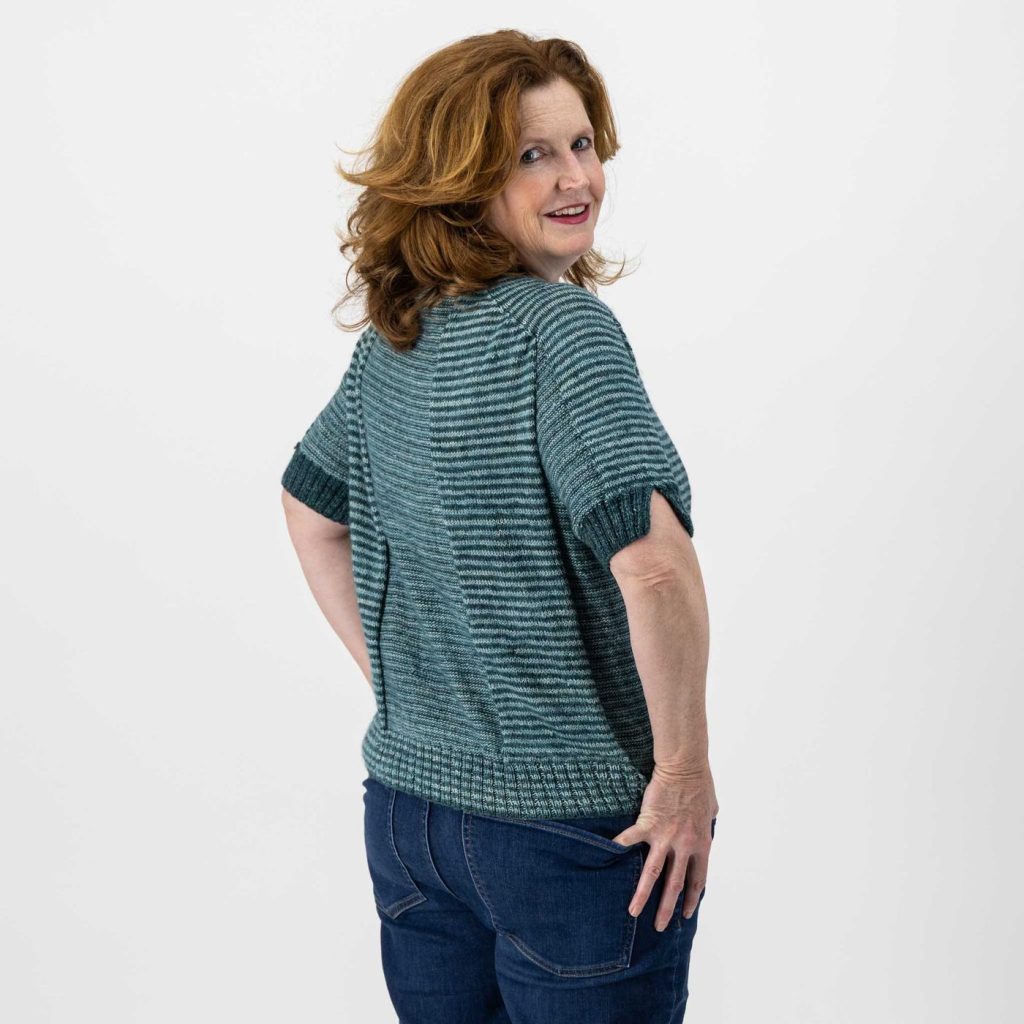
The Anholt T-shirt is a striped tee where two kinds of stitch do the work. Here is the design, our version in Merino Linen, the sizes and what you need to knit it.
We choose patterns to knit for samples for a variety of reasons, many, but not all of them, strategic. Sometimes it’s a super popular one and it’s because “everyone’s doing it” e.g. Ranunculus. Maybe it caught someone’s eye in a particularly gorgeous colour combination on social media. Perhaps we have a good relationship with the designer and want to support them and deepen our connection, or we want to catch the attention of a designer we’d like to work with. It could be a skill that people want to learn and the sample is a good way to demonstrate it. Or we’re looking to showcase what can be done with a particular yarn base, or with certain colours.
The Anholt T-shirt ticked several of these boxes.
- it’s a very interesting stripe construction
- we thought it would be the perfect pattern to combine two of our new colours in Merino Linen
- And the pattern is designed by a Danish studio that we had started talking to about a custom colour collaboration and we wanted to try out a few of their existing patterns
Kit Couture’s Anholt T-Shirt pattern
The Anholt T-shirt is a pattern by Kit Couture, a knitwear design studio in Copenhagen. It belongs to a series of knitted T-shirts named after small Nordic islands. Anholt being a Danish island in the Kattegat.
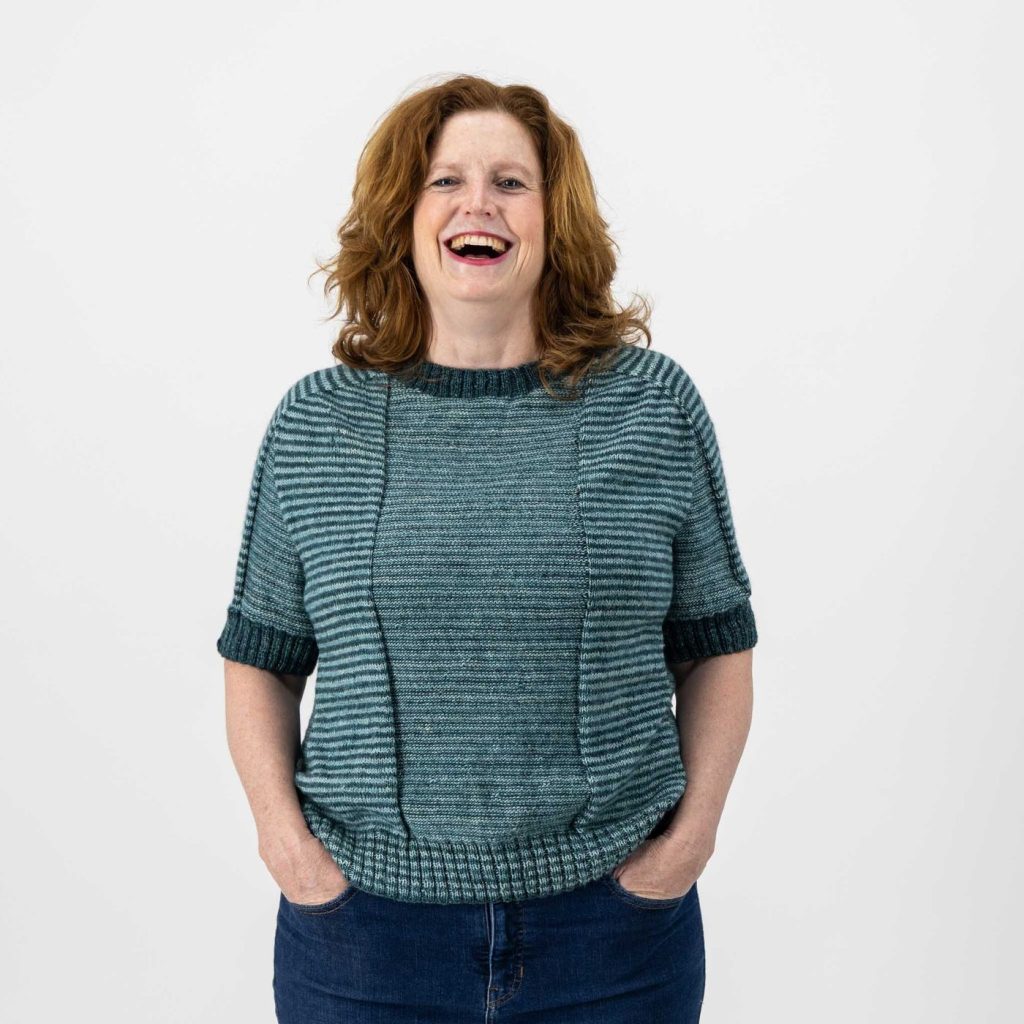
The stripe idea is clever. You work two colours in two-row stripes. But at intervals on each round you switch from regular stocking stitch (knitting in the round) to reverse stocking stitch (purling in the round). In the knit or regular panels the stripes have a clean and well-defined line between the colour changes. In the purl/reverse sections, the two colours break into each other, creating a blurred effect. So one stripe colour sequence creates two quite different fabrics, side by side.
Take a look at the details of our sample on Ravelry here
Project construction:
- Knitted in the round, from the bottom up.
- The sleeves have ribbed edges with with a small slit at the cuff edge.
- Body and sleeves are joined at the yoke, with raglan shaping on all pieces.
- The sleeves carry on into the saddle shoulders, and the neck is shaped at the same time.
The saddle shoulders create a really good fit as the stripes travel over the top of the shoulder instead of stopping at a seam.
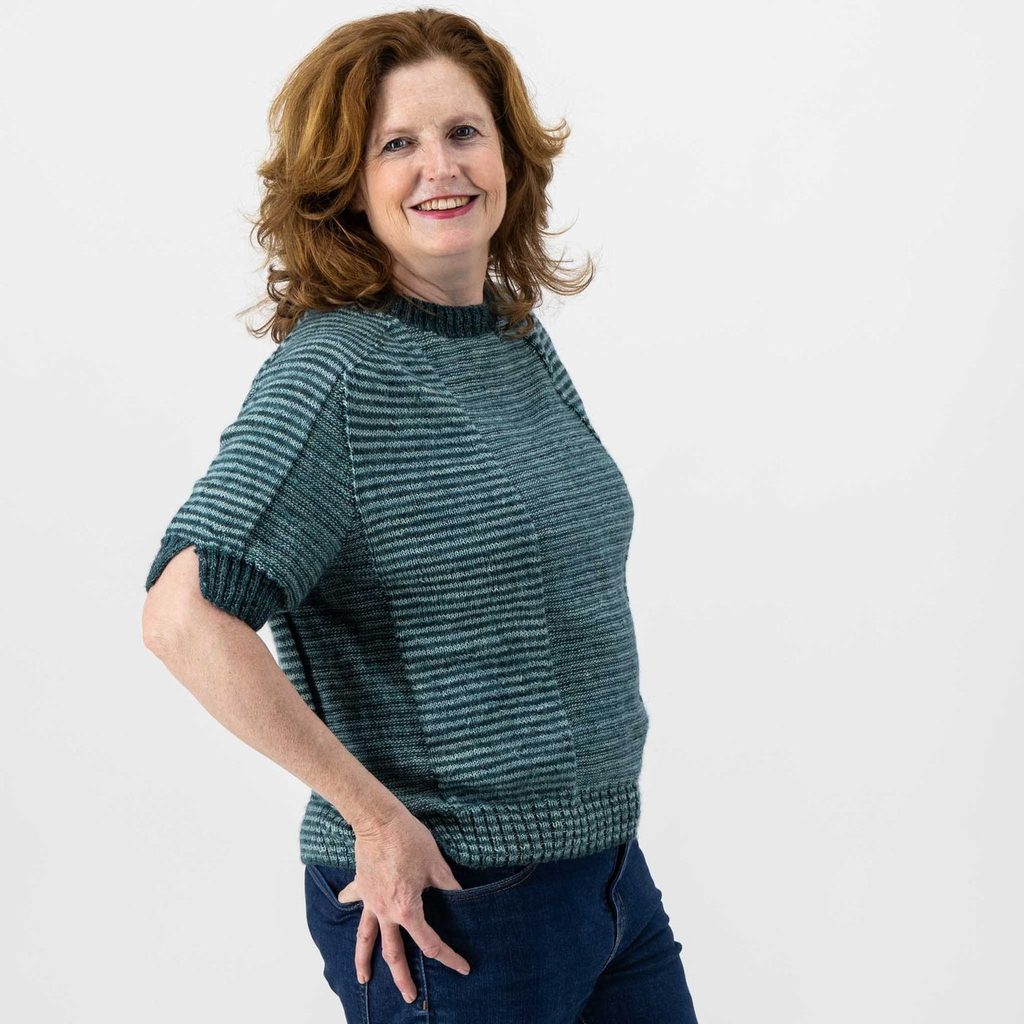
Our version: Merino Linen in High Tide and Low Tide
I chose two similar shades, one light (Low Tide) and one deep (High Tide). With these two, the stocking stitch panels show clear stripes and the reverse panels turn into a soft, heathered teal. You see the construction before you see the stripes. That was the point.
The pattern is designed for a fingering weight yarn and Merino Linen is perfect. It gives good stitch definition. Each panel stays distinct, and the line where one stitch meets the other is easy to see. The fabric is light and drapes from the shoulder rather than standing away from the body.
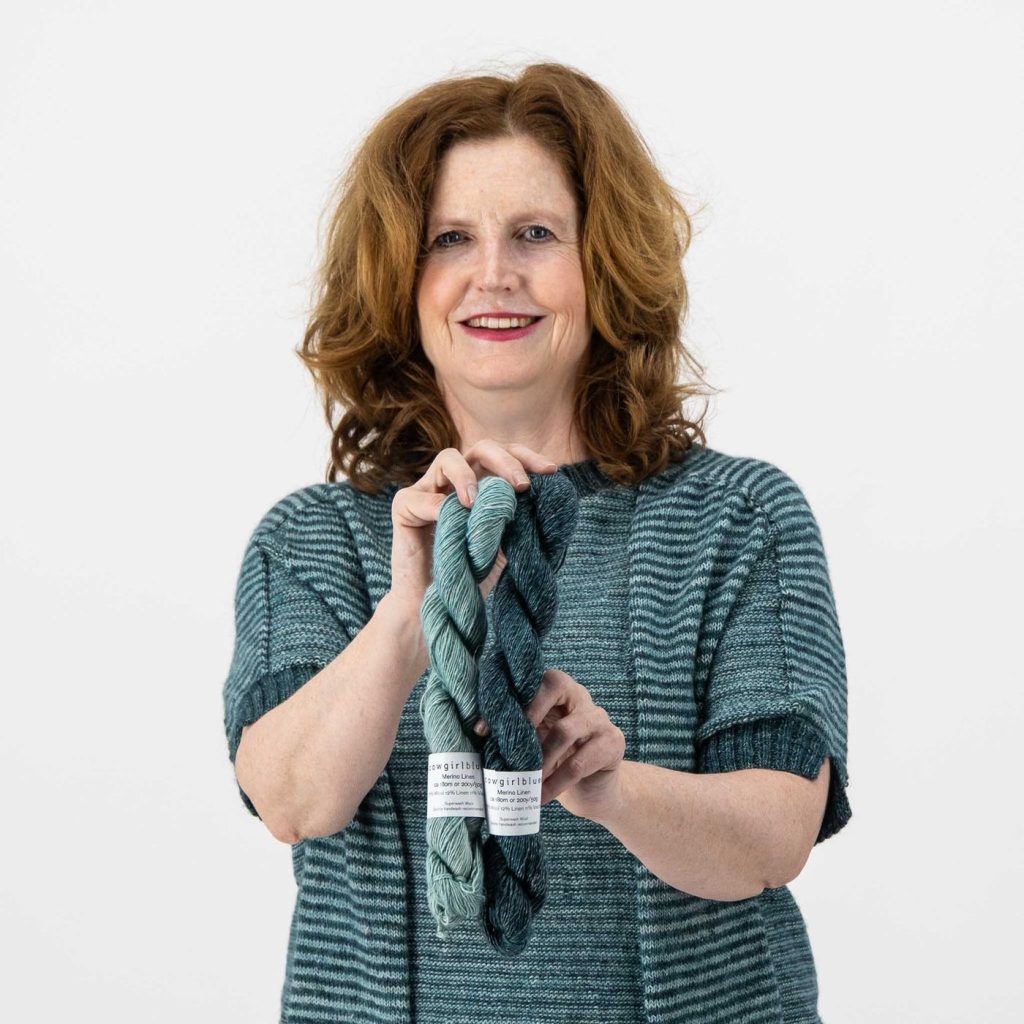
About the yarn:
- 77% superwash merino, 12% linen, 11% viscose
- About 183 m (200 yds) per 50 g
- Hand-dyed in our studio in Maitland, Cape Town
- Our colours are dyed to recipes, so High Tide and Low Tide will look like this when you order them
This is a yarn for every season, although probably not South African mid-summer! I’ve worn the Anholt on its own on warm days and over a long-sleeved top when it is cooler.
Sizes and yarn requirements
The pattern comes in seven sizes, XS to 3XL. Kit Couture suggests about 10 cm of positive ease, so choose the size whose chest width is roughly 10 cm more than your actual bust measurement.
These calculations are based on the pattern information.
*Please note that our XL sample actually used only 200g per colour, ie ~720m/787y of Colour A and Colour B.
| Size | Chest width (cm / in) | Length (cm / in) | Sleeve (cm / in) | Colour A (m / yds) | Colour B (m / yds) | Merino Linen, colours A + B |
|---|---|---|---|---|---|---|
| XS | 88 / 34.5 | 56 / 22 | 10 / 4 | 780 / 853 | 585 / 640 | 250g + 200g |
| S | 96 / 38 | 58 / 23 | 10 / 4 | 780 / 853 | 585 / 640 | 250g + 200g |
| M | 104 / 41 | 60 / 23.5 | 10 / 4 | 780 / 853 | 585 / 640 | 250g + 200g |
| L | 113 / 44.5 | 61 / 24 | 10 / 4 | 780 / 853 | 780 / 853 | 250g + 250g |
| XL | 121 / 47.5 | 62 / 24.5 | 10 / 4 | 975 / 1066 | 780 / 853 | 300g + 250g *We used 200g + 200g |
| 2XL | 130 / 51 | 63 / 25 | 10 / 4 | 975 / 1066 | 780 / 853 | 300g + 250g |
| 3XL | 139 / 54.5 | 65 / 25.5 | 10 / 4 | 975 / 1066 | 780 / 853 | 300g + 250g |
You will also need:
- 2.5 mm and 3 mm circular needles, 40 cm long
- 3 mm circular needle, 80 cm long
- 3 mm double-pointed needles
- The pattern, from Kit Couture on Ravelry or on their website.
The pattern gauge is 28 stitches and 38 rows to 10 cm in stocking stitch on 3 mm needles, after washing and blocking. Swatch in your two colours and wash the swatch before you start. Gauge is really important for ensuring that you’ll get the same fit as the pattern.
Sizes, measurements, needles and gauge are from Kit Couture’s pattern page. Metres are worked out from the pattern requirements and 195m/50g of the recommended yarn.
Other colour pairings
If teal isn’t yours, we put together three more combinations also in Merino Linen. Each one pairs a lighter colour with a deeper one, so you still see the texture in the reverse panels.
- High Tide and Low Tide: Two teals, close in tone. The quietest of the four, pictured in our sample.
- Chilli Pepper and Celadon: A warm red with pale blue-green has more contrast, so the stripes come forward.
- Cacao and Faded Rose: Deep brown with soft dusty pink.
- Mustard and Orchid Blush: Golden yellow with soft lilac.
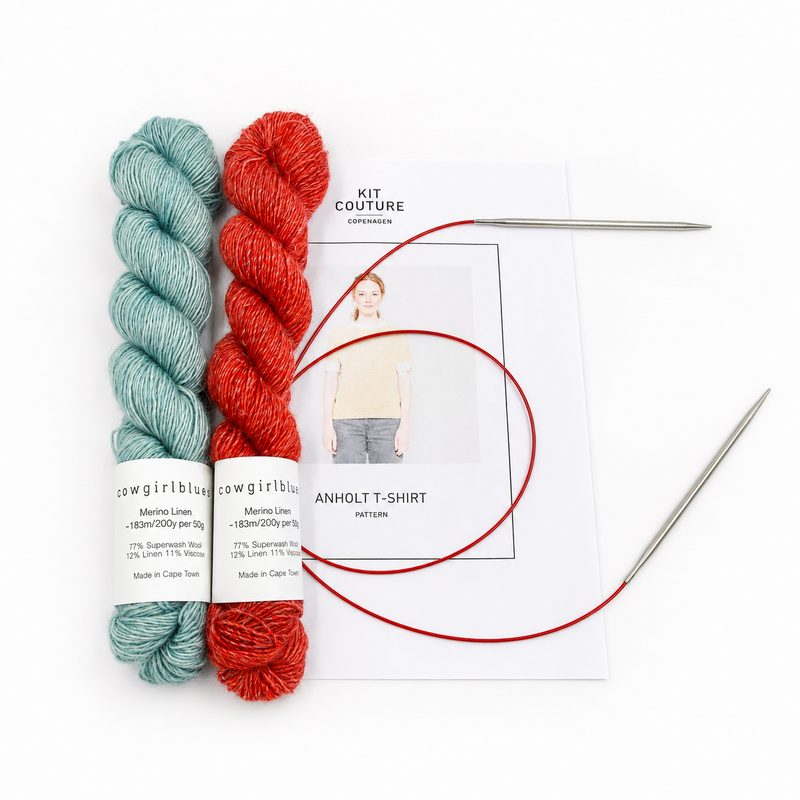
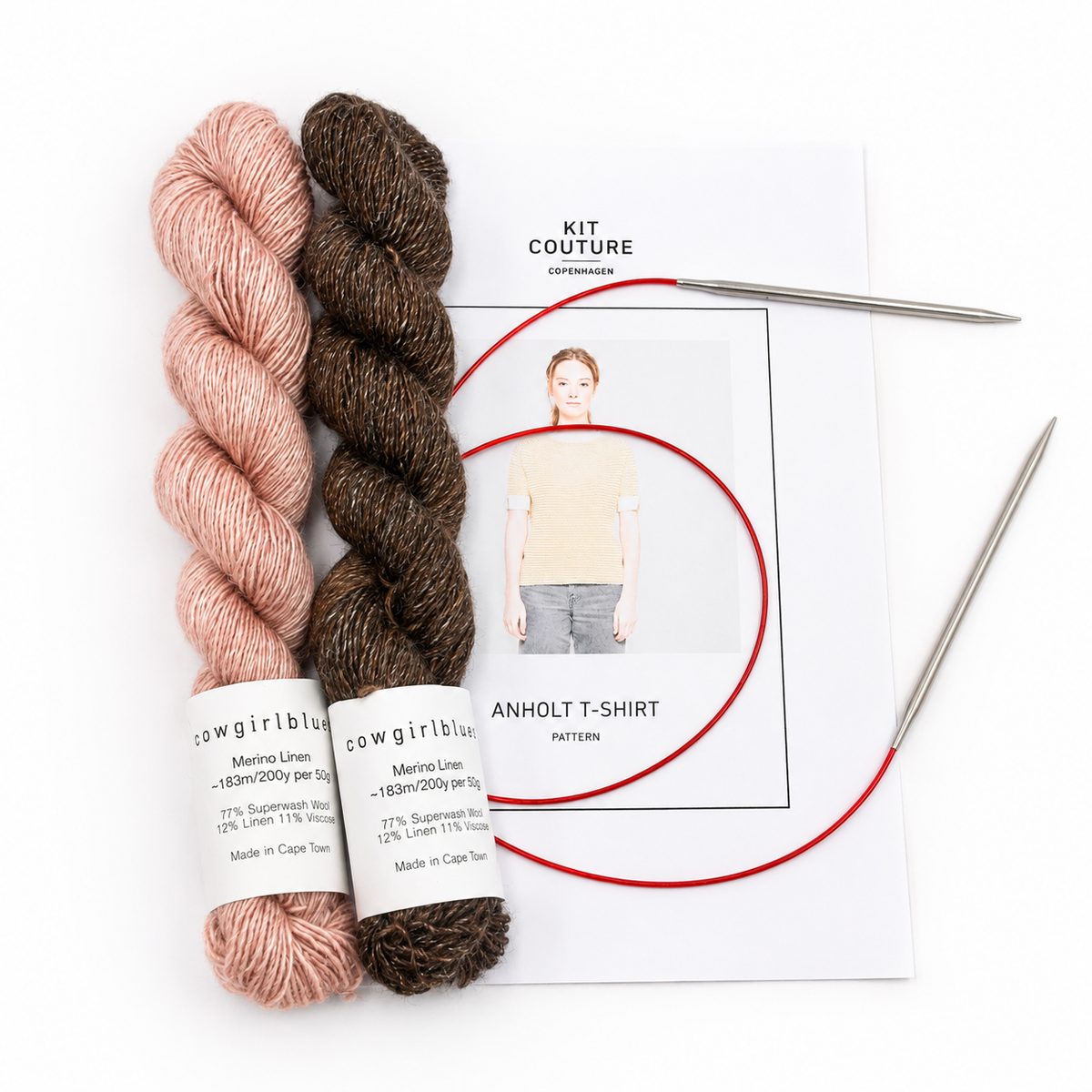
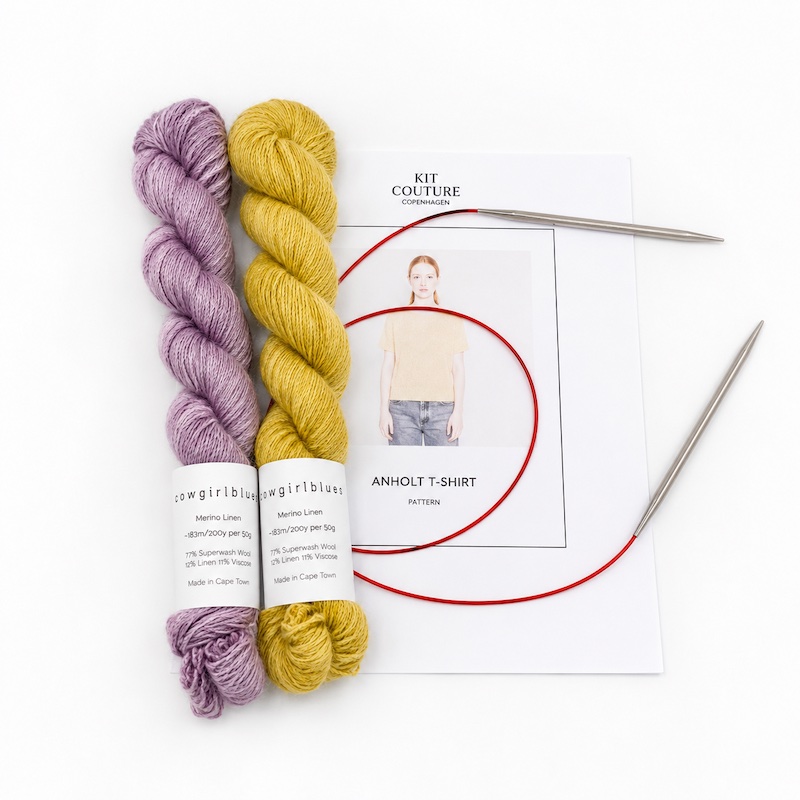
A small tip: the closer the two colours, the more the reverse panels look like a solid heathered fabric. The further apart, the more you will see the broken stripe.
Questions knitters ask
It suits a knitter who has made a top-down or bottom-up sweater before. You will work raglan shaping, saddle shoulders and two-colour stripes, and switch between stocking and reverse stocking stitch across each round. None of it is hard on its own. Together they will require concentration.
All of them. Merino Linen is light and breathable. Wear the tee on its own when it is warm, and layer it over a long-sleeved top or under a jacket when it is cool.
It is a relaxed fit with about 10 cm of ease, 10 cm sleeves with a small slit at the cuff, and a ribbed hem.
The pattern is written for a yarn of about 195 m per 50 g at 28 stitches to 10 cm. Merino Linen, at about 183 m per 50 g, knits to a similar gauge. Our Cowgirlblues Proper Sock would also work. Whatever you choose always swatch first.
Hand wash gently and dry flat.
From Kit Couture, on Ravelry or their website. The yarn is available on our website.
If you knit one, we would love to see which colours you choose. Please tag us on Ravelry or on Instagram at @cowgirrlblues.